DAV Class 8 Science Chapter 7 Question Answer
DAV Solutions Class 8 Science Chapter 7 Combustion is given below. Here DAV Class 8 Science Chapter 7 Question Answer is provided with great explanation. Here we will solve the following topics given below:
A. Fill in the blanks.
1. A good fuel should have its ignition temperature ___________ the room temperature.
2. Burning of cowdung cakes is an example of ___________ combustion.
3. The ___________ zone of a candle flame, is the coldest.
4. The non-luminous zone of a candle flame is the ___________ part of the flame.
5. During incomplete combustion of a fuel, ___________ gas is formed.
Answer: (1) above (2) slow (3) innermost (4) hottest/outer most (5) Carbon monoxide
B. State True or False for the following statements.
1. Coal is an inflammable fuel.
2. The outermost part of a candle flame contains unburnt carbon particles.
3. The heat produced, by burning completely one kilogram of a given fuel, is known as the efficiency of that fuel.
4. All solid fuels have a higher calorific value than liquid and gaseous fuels.
5. Sulphur dioxide gas, produced during combustion of fossil fuels, causes acid rain.
Answer: (1) False (2) False (3) True (4) False (5) True
C. Tick the correct option.
1. An example of a non-combustible substance is-
Answer: iron
2. A fuel starts burning only when it is heated to-
Answer: its ignition temperature
3. The highest temperature zone of a candle flame, is its-
Answer: blue zone
4. The amount of heat produced, on complete burning of 10 kg of a given fuel, in pure oxygen, equals H kilojoule. The calorific fuel, of that fuel, would equal-
Answer: (0.1 H) kJ/kg
5. The gas produced, due to incomplete combustion of carbon fuels, is-
Answer: carbon monoxide
D. Answer the following questions in brief.
1. Define the term ‘combustible material’? Give two examples of combustible materials.
Answer: A material, which on heating in the presence of air (or oxygen), catches fire easily and produces heat and light energy is called combustible material.
Examples – coal and wood.
2. State the three conditions that are needed for combustion to take place.
Answer: Three conditions are –
- There is a combustible material;
- There is a continuous supply of air; and
- The temperature of combustible material is higher than its ignition temperature.
3. State the condition under which ‘slow combustion of a material takes place.
Answer: Slow combustion usually occurs when there is an insufficient supply of air.
4. Define ‘calorific value of a fuel.
Answer: The amount of heat energy produced on completely burning one kilogram of a fuel in pure oxygen is called the calorific value of a fuel.
5. State any two characteristics of an ideal fuel.
Answer: Two characteristics of an ideal fuel are:
- be cheap, readily available and easy to transport.
- have a high calorific value.
6. Why is water not used in controlling electrical fires?
Answer: If the fire is caused by an electric, then it should not be extinguished by pouring water because the electric current will flow through water, thereby, giving a severe electric shock which may prove fatal.
E. Answer the following questions.
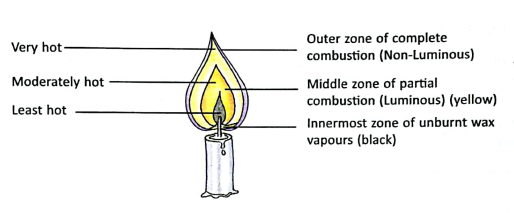
1. Draw a diagram showing the different zones of candle flame. Label the zone which contains:
(a) unburnt vapours of wax.
Answer: Innermost zone
(b) unburnt carbon particles.
Answer: Middle zone
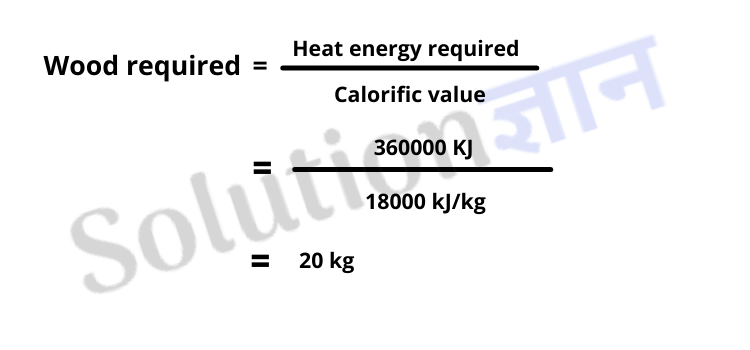
2. Calorific value of wood is 18,000 kJ/kg. How much of wood is required to produce 360,000 kJ of heat energy?
Answer:
3. Why are gaseous fuels considered better than liquid or solid fuels.
Answer: Gaseous fuels considered better than liquid or solid fuels because
- Gaseous fuels are easy to transport, it can be supplied in cylinders, or though pipeline.
- Gaseous fuels release large amount of energy;
- they also do not leave behind any ash or solid residue on combustion.
- Gaseous fuels produce least amount of harmful gases as compared to solid and liquid fuels.
4. Why do we say that ‘burning of fuels’ can cause ‘health hazards’?
Answer: we say that ‘burning of fuels’ can cause ‘health hazards’ because
a) Incomplete combustion of carbon fuels results in the formation of carbon monoxide gas. It is a very poisonous gas. Even small amounts of it can cause breathing problems.
b) Burning of coal and diesel releases sulphur dioxide gas. It is an extremely suffocating gas and forms acid with rain water which can damage buildings, plants and trees.
c) Burning of fuels releases carbon dioxide gas which causes global warming. This result in the melting of polar glaciers, which, in turn, can lead to a rise in the sea level, causing floods in the coastal areas.
No comments:
Post a Comment