Tuesday, May 9, 2023

DAV Class 8 Science Chapter 8


DAV Class 8 Science Chapter 8 Question Answer

DAV Class 8 Science Chapter 8 Solutions: DAV Solutions for Class 8 Science Chapter 8 Conservation of Plants and Animals Question Answer is given below. Here DAV Class 8 Science Chapter 8 Question Answer is provided with great explanation.

1. International Day for biological diversity is observed on ___________.

2. A group of organisms, capable of interbreeding under natural conditions, is known as a ___________.

3. ___________ species are the species that are found only in a particular area.

4. ___________ is an important reserve for Project Tiger.

5. ___________ sanctuary in Odisha is the breeding ground for the ‘giant olive ridley turtle’ which migrate here from the Pacific Ocean.

Answer: (1) May 22 (2) species (3) endemic (4) Bandipur National Park (5) Gahirmatha Turtle

1. Protection, and preservation of wildlife and natural resources, is known as-

Answer: conservation

2. The cheetah is a vulnerable species because-

Answer: it will be ‘extinct soon.

3. Plants, found in a particular area, are referred to as-

Answer: flora

4. Which one of the following is not an outcome of deforestation in an area?

Answer: increased rainfall.

5. A region, in which ‘conservation of biodiversity’ in its natural habitat is practised, is known as a-

Answer: national park

1. How have ‘urbanisation and industrialisation’ led to a large scale deforestation’?

Answer: Forest land is being sacrifices for massive development projects that have become a necessary part of urbanization and industrialization. Forests are being used as a source of raw material for paper, medicines, pulp, and furniture etc. All these factors have led to the indiscriminate cutting down of trees in the forests.

2. A new species X is introduced in a forest. How is it likely to affect the local species of the area?

Answer: If a new species is introduced in the particular area, the local species will be affected in the following ways:

  • The local species may not get proper shelter, water and food for their survival.
  • They may prey on the local species.
  • It may change food chain or food web.
  • Some the species may extinct.

3. What is a Biosphere Reserve? Name two biosphere reserves in India.

Answer: It is an international protected area (designated by UNSECO); meant to have a balanced relationship between man and nature, along with promoting sustainable development.

Two examples of biosphere reserves in India are: Nilgiri Biosphere Reserve and Nanda Devi Biosphere Reserve.

4. How does the ‘Red data book’ help in protecting biodiversity?

Answer: Red Data Book is a document that keeps a record of all the endangered species of animals, plants, and fungi in a country or a state. With the help of this book, we can estimate the risk and provides a framework or guidelines for implementing protective measures for endangered species.

5. Why do some birds and animals migrate?

Answer: Some birds and animals need to migrate to find abundant food and a favourable place to breed.

6. How do birds ‘get helped’ in navigation while undertaking long distance flights?

Answer: Birds have much sharper eyesight and better virtual memory of ground clues than humans. However, in long-distance flights, birds appear to navigate with the help of the Sun and stars, possibly in combination with a ‘reading’ of the Earth’s magnetic field. This is achieved through an inbuilt ‘magnetic compass, which is a tiny mass of tissue, between the eye and the brain, in birds.

7. Distinguish between a National Park and a Wildlife Sanctuary.

Answer: Distinguish between a National Park and a Wildlife Sanctuary are:

National ParkWildlife Sanctuary
No human activities are allowed.Human activities are allowed.
Boundaries are fixed and defined.There are no fixed boundaries.
Not usually open to the public.It is open to the general public.

1. Explain how deforestation can result in droughts and floods.

Answer: The roots of the trees help the soil to bind up properly. Deforestation of trees led to the frequent floods and drought, because the soil loosens up the binding due to cutting of trees. Thus, when there is rain, soil erosion and flood take place.

As for drought, deforestation leads to global warming and reduces the water cycle of that place resulting to less rain fall.

2. ‘Extinction of tiger can destabilise the entire forest ecosystem and result in a large-scale loss of biodiversity.” Justify this statement.

Answer: If the tigers get extinct, then the food chain will get disturbed and the number of herbivorous animals will increase. This will result in excess of grazing of plants. Plants are the ultimate source of food, therefore, there will be shortage of food for everyone and many species will face extinction.

3. Why are endemic species at a greater risk of becoming extinct? List the human action related causes’ that are responsible for their extinction.

Answer: Endemic species are found only in a particular area; hence, it is all the more important to conserve them. Habitat loss, overexploitation, introduction of new species and disruption of ecosystems, are the main reasons for the extinction of endemic species.

4. “The growing human population poses a grave threat to biodiversity”. Justify this statement.

Answer: An increase in human population is affecting biodiversity by taking up more forest land which treats the lives of various plants and animals. Forests are also being used as a source of raw material for various industries. Deforestation has led to both domestic and global consequences.

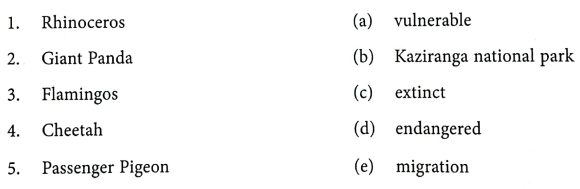
5. Explain the difference between extinct, endangered and vulnerable species.

Answer: Difference between extinct, endangered and vulnerable species are:

Extinct: A plant, or an animal, which is now not found anywhere on the earth are extinct species.

Endangered: A Species of plant, or an animal, which is at a high risk of extinction in the near future.

Vulnerable: The plants and animals that are found only in one particular geographical area, and nowhere else are vulnerable species.

6. List five ways in which you, as an individual, can contribute to conserving forests and wildlife.

Answer: Five ways in which we, as an individual, can contribute to conserving forests and wildlife are:

1. By planting more and more trees.

2. By reducing wastage of paper

3. By creating awareness among the people to conserve forest and wildlife.

4. By optimum utilization of forest products.

5. By adopting the policy of three Rs-Reduce, Reuse, Recycle.


DAV Solutions Class 8 Science Chapter 7


DAV Class 8 Science Chapter 7 Question Answer

DAV Solutions Class 8 Science Chapter 7 Combustion is given below. Here DAV Class 8 Science Chapter 7 Question Answer is provided with great explanation. Here we will solve the following topics given below:

1. A good fuel should have its ignition temperature ___________ the room temperature.

2. Burning of cowdung cakes is an example of ___________ combustion.

3. The ___________ zone of a candle flame, is the coldest.

4. The non-luminous zone of a candle flame is the ___________ part of the flame.

5. During incomplete combustion of a fuel, ___________ gas is formed.

Answer: (1) above (2) slow (3) innermost (4) hottest/outer most (5) Carbon monoxide

1. Coal is an inflammable fuel.

2. The outermost part of a candle flame contains unburnt carbon particles.

3. The heat produced, by burning completely one kilogram of a given fuel, is known as the efficiency of that fuel.

4. All solid fuels have a higher calorific value than liquid and gaseous fuels.

5. Sulphur dioxide gas, produced during combustion of fossil fuels, causes acid rain.

Answer: (1) False (2) False (3) True (4) False (5) True

1. An example of a non-combustible substance is-

Answer: iron

2. A fuel starts burning only when it is heated to-

Answer: its ignition temperature

3. The highest temperature zone of a candle flame, is its-

Answer: blue zone

4. The amount of heat produced, on complete burning of 10 kg of a given fuel, in pure oxygen, equals H kilojoule. The calorific fuel, of that fuel, would equal-

Answer: (0.1 H) kJ/kg

5. The gas produced, due to incomplete combustion of carbon fuels, is-

Answer: carbon monoxide

1. Define the term ‘combustible material’? Give two examples of combustible materials.

Answer: A material, which on heating in the presence of air (or oxygen), catches fire easily and produces heat and light energy is called combustible material.

Examples – coal and wood.

2. State the three conditions that are needed for combustion to take place.

Answer: Three conditions are –

  • There is a combustible material;
  • There is a continuous supply of air; and
  • The temperature of combustible material is higher than its ignition temperature.

3. State the condition under which ‘slow combustion of a material takes place.

Answer: Slow combustion usually occurs when there is an insufficient supply of air.

4. Define ‘calorific value of a fuel.

Answer: The amount of heat energy produced on completely burning one kilogram of a fuel in pure oxygen is called the calorific value of a fuel.

5. State any two characteristics of an ideal fuel.

Answer: Two characteristics of an ideal fuel are:

  • be cheap, readily available and easy to transport.
  • have a high calorific value.

6. Why is water not used in controlling electrical fires?

Answer: If the fire is caused by an electric, then it should not be extinguished by pouring water because the electric current will flow through water, thereby, giving a severe electric shock which may prove fatal.

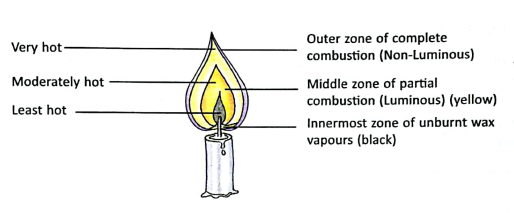
1. Draw a diagram showing the different zones of candle flame. Label the zone which contains:

(a) unburnt vapours of wax.

Answer: Innermost zone

(b) unburnt carbon particles.

Answer: Middle zone

DAV Solutions Class 8 Science Chapter 7 Combustion
Diagram of candle flame

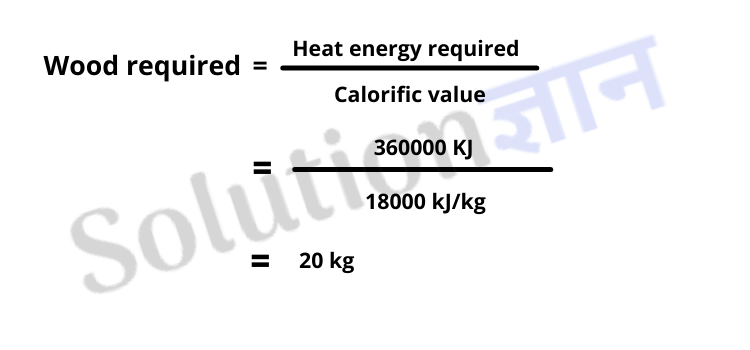
2. Calorific value of wood is 18,000 kJ/kg. How much of wood is required to produce 360,000 kJ of heat energy?

Answer:

DAV Solutions Class 8 Science Chapter 7 Combustion
DAV-Class-8-Science

3. Why are gaseous fuels considered better than liquid or solid fuels.

Answer: Gaseous fuels considered better than liquid or solid fuels because

  • Gaseous fuels are easy to transport, it can be supplied in cylinders, or though pipeline.
  • Gaseous fuels release large amount of energy;
  • they also do not leave behind any ash or solid residue on combustion.
  • Gaseous fuels produce least amount of harmful gases as compared to solid and liquid fuels.

4. Why do we say that ‘burning of fuels’ can cause ‘health hazards’?

Answer: we say that ‘burning of fuels’ can cause ‘health hazards’ because

a) Incomplete combustion of carbon fuels results in the formation of carbon monoxide gas. It is a very poisonous gas. Even small amounts of it can cause breathing problems.

b) Burning of coal and diesel releases sulphur dioxide gas. It is an extremely suffocating gas and forms acid with rain water which can damage buildings, plants and trees.

c) Burning of fuels releases carbon dioxide gas which causes global warming. This result in the melting of polar glaciers, which, in turn, can lead to a rise in the sea level, causing floods in the coastal areas.


DAV Solutions Class 8 Science Chapter 6


DAV Class 8 Science Chapter 6 Question Answer

DAV Solutions for Class 8 Science Chapter 6 Sources of Energy is given below. Here DAV Class 8 Science Chapter 6 Question Answer is provided with great explanation. Here we will solve fill in the blanks, true or false, tick the correct option, answer the following questions in brief and answer the following questions or long answer question.

1. ___________ and ___________ are non-renewable sources of energy.

2. ___________ is a major renewable, natural resource.

3. The process, in which coal is strongly heated in the absence of air, is known as ___________.

4. In oil wells, ___________ is always found above the layer of petroleum.

5. ___________ is a black viscous liquid, obtained by destructive distillation of coal.

Answer: (1) Coal, petroleum (2) Wood (3) destructive distillation (4) natural gas (5) Coal tar

1. Fossil fuels are renewable natural resources.

2. Anthracite has higher carbon content than lignite.

3. Coke can be used to make fuel gases.

4. Natural gas is found below the petroleum layers.

5. Burning of fossil fuels is a major source of pollution.

Answer: (1) False (2) True (3) True (4) False (5) True

1. The highest grade of coal is known as-

Answer: anthracite

2. Coke and coal tar are obtained from-

Answer: coal

3. Different types of coal generally have the-

Answer: different content of volatile material as well as different percentage of carbon.

4. A product, that is not obtained through the refining of petroleum, is-

Answer: coal gas

5. Which of the following is a renewable source of energy?

Answer: tidal energy

1. Define the term ‘fuel’.

Answer: Substances which produce heat on burning in air are called fuels.

2. Name any two renewable natural sources of energy.

Answer: Wind energy and water energy.

3. Define the term ‘carbonisation’.

Answer: The process, of conversion of dead plant materials into coal, is called carbonisation.

4. Name the three main products obtained from destructive distillation of coal.

Answer: Coke, Coal Tar & Coal gas.

5. State two uses each of the following:

(a) asphalt

Answer: Two uses of asphalt are:

  • It is used for making roads.
  • It is also used for coating the underside of electric poles to prevent their rusting.

(b) paraffin wax

Answer: Two uses of paraffin wax are:

  • It is used as grease.
  • It is also used for making vaseline, ointments and candles.

6. Write the full forms of CNG, LPG and PNG.

Answer:

CNG – Compressed Natural Gas.

LPG – Liquified Petroleum Gas.

PNG – Piped Natural Gas.

1. Describe, in brief, the process of ‘coal formation’.

Answer: Coal was formed from plant remains got buried deep under the earth’s crust. Over a large period of time, the chemical and physical properties of these plant remain were changed through geological action that leads to the creation of the solid material i.e., Coal.

2. Differentiate between lignite and bituminous coal.

Answer: Differentiate between lignite and bituminous coal are:

Lignite CoalBituminous Coal
1. It has carbon content of about 38 per cent.1. It has carbon content about 65 per cent.
2. It has been mainly used for electric power generation.2. It is used for making coke (other type of fuel) and also for power generation.
3. It produces low heat energy.3. It produces more heat energy.
4. It has high moisture content.4. It has low moisture content.
5. It is regarded as the lowest grade of coal.5. It is regarded as the middle grade coal.

3. How do petroleum and natural gas occur in nature?

Answer: Petroleum is found at moderate depths (500m – 2000m) between two layers of impervious rocks. Petroleum deposits are usually found mixed with salt water. Petroleum being lighter than salt water, floats over it. Natural gas is found above petroleum; it is trapped between the rock cap and the petroleum layer.

4. State the main advantages of using natural gas.

Answer: The main advantages of using natural gas are:

  • It burns readily and has a high calorific value.
  • It is easy to carry and store.
  • It undergoes complete combustion and can be controlled easily.
  • It is a cleaner fuel as it releases relatively low amounts of gaseous pollutants.
  • Do not leave ash particles after burning.

5. Keeping in mind their availability in nature, explain the need of using coal and petroleum judiciously.

Answer: Coal and petroleum are limited and take millions of years for their formation. i.e., they are non-renewable. Hence these fossil fuels should be used judiciously so that they will be available to future generations for useful products.